mistakes to avoid
What goes wrong when I collect costume measurements from parents by email each spring?
Most costume sizing disasters trace back to how the numbers were gathered. These are the collection errors that produce late orders, wrong sizes and a fitting week you cannot recover from.
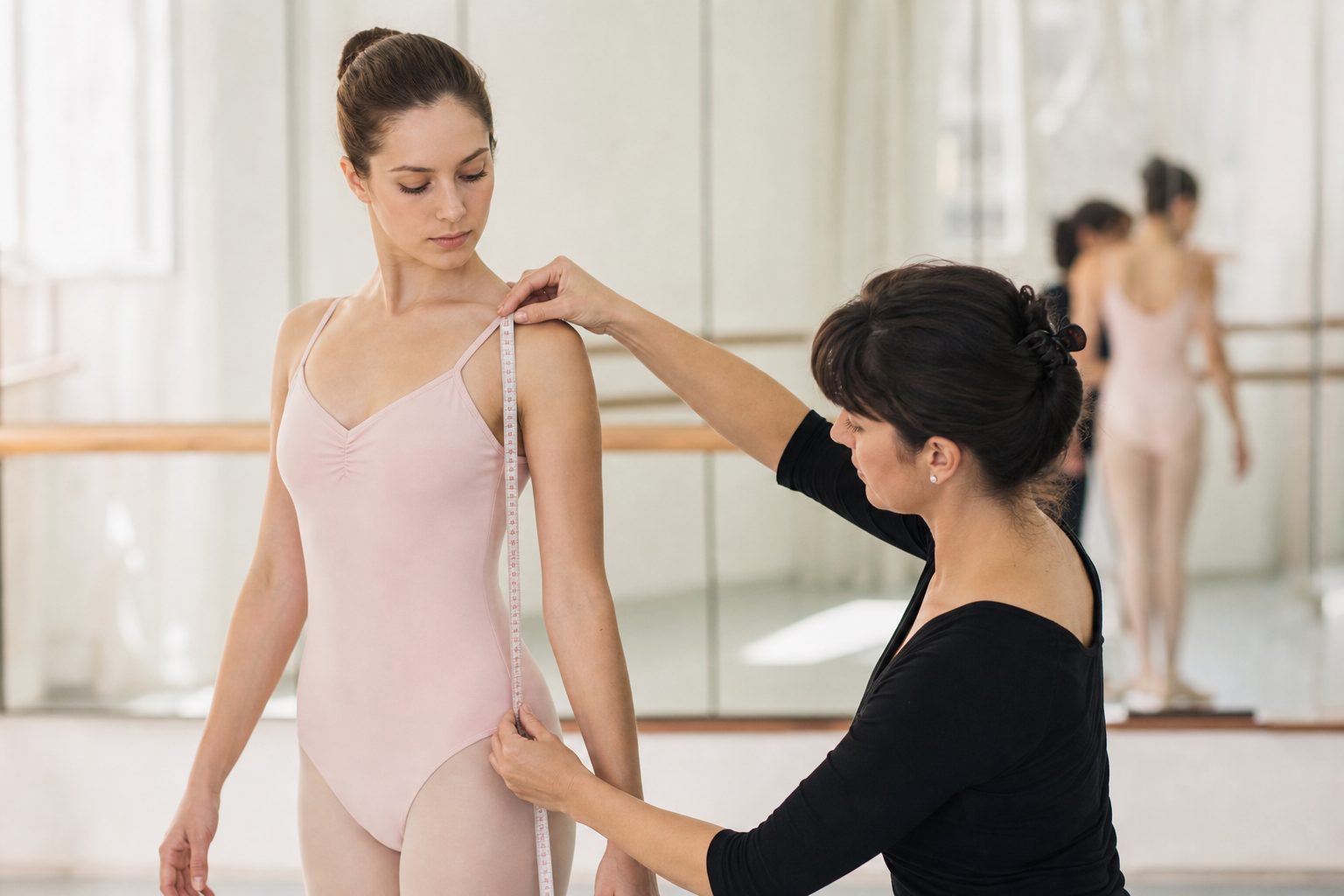
What goes wrong is that email is a collection method with no structure, no validation and no completion state. Parents reply with a size instead of numbers, they skip the measurement they have never heard of, they answer in a thread you cannot find in March, and a good number never answer at all. You end up reconstructing a class list from memory two days before the vendor deadline.
None of that is a parent problem. Measuring a wriggling six year old with a cloth tape is genuinely awkward, and most families have never been told what girth is. The failure is in the collection design, not in the families.
Below are the specific errors that produce late orders and wrong sizes, in the order they usually happen, and what to do instead.
Letting parents guess a size instead of sending measurements
When you ask "what size does she wear," you get a retail clothing size, and retail sizing has nothing to do with dancewear sizing. A child who wears a 7 in school clothes may be a child small or an intermediate child depending on the manufacturer, and manufacturers do not agree with each other.
Costume vendors publish their own size charts with numeric ranges for chest, waist, hips and girth. Those charts are the authority. Your job in collection is to gather the numbers that let you read the chart, not to gather an opinion.
Ask for measurements in inches, to the nearest quarter inch, with a soft tape. Then you or your costume coordinator assigns the size against the chart for the specific costume being ordered, because two costumes from the same vendor can size differently depending on the fabric and cut.
If a parent insists on giving a size, take it as a sanity check, not as the order. A large gap between the stated size and the measured size is a signal to remeasure, and catching that in January is cheap.
Keep reading: Do I need a license, background checks and insurance to run a children's dance school?
Measuring over the wrong clothing and in the wrong order
Measure over a leotard or over close fitting underclothes. Over a sweatshirt you add two inches to a chest and turn a child small into a child large.
Shoes off. Hair down and out of the way for the girth measurement path. Tape snug against the body but not pulled tight, and level all the way around, which is the part most people get wrong because they let the tape ride up in the back.
Give the sequence, not just the list, because a sequence is followable and a list invites skipping:
- Height: against a wall, shoes off, heels together.
- Chest: around the fullest part, tape level under the arms.
- Waist: the natural waist, the narrowest point, not where the pants sit.
- Hips: around the fullest part of the seat, feet together.
- Girth: the one below.
- Inseam: crotch to floor, for anything with a footed or ankle length leg.
Write it on one page with a simple diagram, in the words you would use standing next to the parent. A page a family can hold in one hand while measuring with the other is worth more than three paragraphs in an email body.
Girth: the measurement parents skip and every leotard needs
Girth is the loop measurement taken from the top of the shoulder, down the front of the body through the crotch, up the back, and back to the same shoulder point. It is the single most important number for any one piece garment, because it determines whether a leotard or costume bodice will pull down on the shoulders or ride up in the seat.
It is also the one nobody has heard of. If you do not explain it, you get a blank field, or worse, you get a waist measurement typed into the girth box because the parent assumed it was another word for the same thing.
Two things fix it. Explain it in a sentence and a picture. And validate the number when it arrives: girth on a child is roughly the sum of height and chest ranges in ways that make an implausible value obvious. A girth of 24 inches on a nine year old is not a girth, it is a waist, and it should be caught the moment it is entered, not at the fitting.
No deadline, or a deadline with no consequence
A deadline with no consequence is a suggestion. If the message says measurements are due February 10 and nothing at all happens on February 11, the informal deadline becomes the day you send the panicked reminder.
Attach something real to the date. The standard options, any of which work if stated in advance:
- A late fee added to the costume fee after the date, priced at what a rush order actually costs you.
- Ordering to the studio's best estimate from the previous season's measurement, with no exchanges.
- The dancer being placed in the finale only rather than a costumed number, for classes where that is workable.
Set the deadline well ahead of the vendor cutoff, not on it. If your vendor needs the order by March 1 for a June recital, ask families for measurements by February 1. That four week gap is where you chase the stragglers, run the sanity checks and handle exchanges, and it is the difference between a calm February and a rush shipping charge.
Keep reading: How did one studio move from paper enrollment to a filled term without losing families?
Missing dancers and the class list that never gets reconciled
The most expensive error is not a wrong measurement, it is a dancer who was never counted. Email cannot tell you who has not replied, because absence of a reply looks exactly like an email you have not read yet.
You need a roster view: every enrolled dancer in every recital number, with a state next to each name. Submitted. Missing. Flagged for review. Ordered.
Reconcile against the class roll, not against your inbox, and do it weekly from the day collection opens. Watch for the three cases email always loses:
- The dancer in two numbers who needs two costumes but whose parent submitted once and assumed it covered both.
- The mid year joiner who enrolled in January, after the collection message went out in December.
- The sibling collision, where one parent submitted measurements for two children and the second child's numbers ended up in one form.
Ordering to the current size instead of the recital date
Measurements taken in January describe a January child. The recital is in May or June. Children grow, and the youngest grow the most.
The vendor size chart is your first guard, because charts are built on ranges. When a measurement falls in the middle of a range, order that size. When it falls in the top quarter of a range, or within about a half inch of the top, size up. Costumes can be taken in at the straps and the waist far more easily than they can be let out.
Give the guidance more weight for the youngest dancers, where four or five months is a visible amount of growth, and less for teenagers, who are more likely to be near their adult frame.
And note the rule you are applying next to the order, so that in April when a costume is snug you can see whether you sized up and it still grew, or whether you ordered to the exact number.
See how TutuTerm handles this for dance and ballet schools
Not recording who measured and when
Every measurement should carry three pieces of metadata: the date it was taken, who took it, and whether it was measured at the studio or at home.
This is not bureaucracy. It is what lets you answer the April question. A measurement taken by a teacher at the studio in February is trustworthy. A measurement submitted from home in November by a parent, for a child who has since had a growth spurt, is a candidate for a recheck.
It also settles the cost conversation. If the studio measured and the costume is wrong, that is yours to fix. If the parent measured at home and declined the fitting night, the exchange fee is theirs. Neither of those is a comfortable conversation, but both are short when the record says who did what and on what date.
Building one fitting night that replaces a month of email
The single highest return change most schools can make is to stop collecting measurements remotely and hold a fitting night instead.
Here is a structure that works in a two studio building on a weekday evening:
- Schedule it against class times. Dancers get measured before or after their regular class, so families make no extra trip.
- Two measuring stations, two people each. One measures and calls the numbers, one records. Never one person doing both.
- Sample sizing garments where you can get them. A trial leotard in three sizes settles more arguments than any tape.
- Enter numbers as you go, into the roster, not onto a clipboard to be transcribed later. Transcription is where digits swap.
- Mark the roster live, so at the end of the evening you know exactly who is still missing.
- Run a make up window, one Saturday morning, for the families who could not attend. Then and only then, allow home measurement.
An evening like that measures a hundred and fifty dancers in about three hours with four staff. Compare that against a month of reminder emails, three rounds of chasing and the exchanges you pay for afterward, and the fitting night is not the expensive option.
Fixing the collection, not the symptoms
Explain each measurement, give a sequence, set a deadline with teeth, validate the numbers as they arrive, and reconcile against the class roll rather than your inbox. Every one of these errors is a design problem with a design fix.
TutuTerm handles the collection side of that directly: costume sizing captured per dancer against the class placement made at enrollment, so you can see who has submitted, who has not, and which numbers need a second look before the order goes to the vendor.
Read also

Do I need a license, background checks and insurance to run a children's dance school?
Requirements sit at three levels: state business registration, local occupancy and fire rules for the studio, and screening obligations for staff working with minors. Here is how they fit together.

How did one studio move from paper enrollment to a filled term without losing families?
A composite account of a three studio ballet school that replaced its paper enrollment week with staged placement, a sizing window and phased recital billing, and what each change actually fixed.
Is a competition team the direction my recreational ballet school should be heading next?
Competition programs raise revenue per family and raise cost, staffing and calendar pressure with it. A clear look at what a team changes in a recreational school built around term classes and one spring recital.