comparison
Should I rent recital costumes or buy them outright for every dancer in my school?
Renting keeps parent cost down and storage small. Buying gives families a keepsake and you a predictable margin. Compare the two on cash flow, sizing risk, cleaning and what happens when a dancer withdraws.
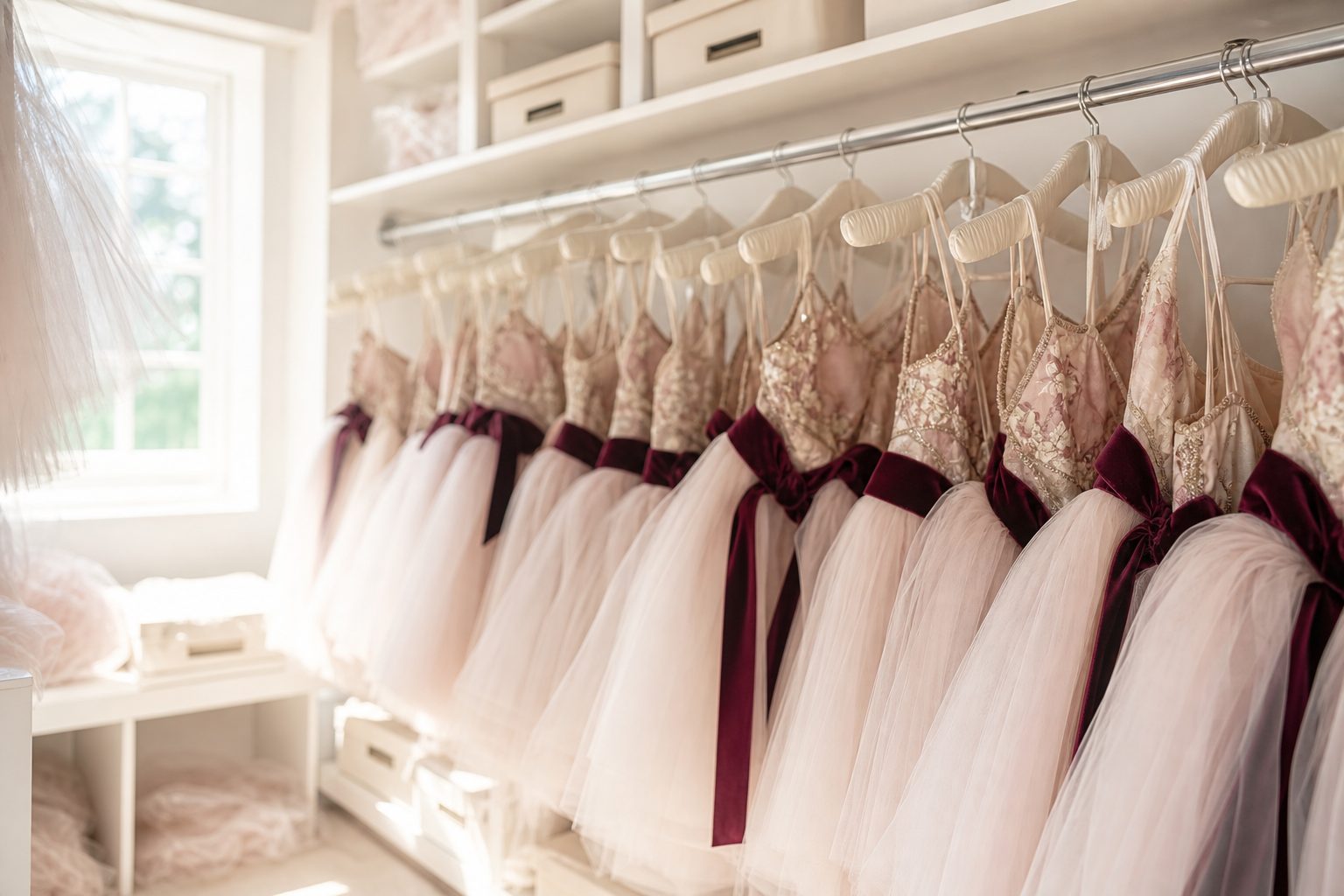
For most children's schools, buying is the right default and renting is the right exception. Buying moves the cost, the sizing risk and the cleaning to the family, gives you a clean per dancer fee, and leaves you with nothing to store in July. Renting lowers what a parent pays in any single spring, but it hands you inventory, laundering, damage claims and a size run you have to maintain for years.
The exception that argues for renting is a costume you will use repeatedly and that no child wants to keep: a corps tutu for a classical variation, a character piece for a Nutcracker party scene, an ensemble look for your pre professional levels who dance the same repertoire annually.
The decision is really about how many times a garment will be worn. A costume worn once and taken home is a purchase. A costume worn by a different dancer every year for six years is an asset, and assets need a program around them.
What a rental program actually requires: inventory, cleaning, deposits
A rental program is a small warehouse business attached to a dance school. Before the first rental you need a numbered inventory: every piece tagged with an ID, a size, a condition note and a photo. Without unique IDs you cannot tell which of your eleven pale rose bodices came back with a torn hook.
You need a size run, not a size. A single classical tutu design in child sizes might mean six to ten physical garments to cover one class, and the class composition changes every year. That is why rental works best where costumes are standardized across a level and worn by a group.
Then the operating pieces:
- A rental agreement per dancer naming the garment ID, the return date and the damage terms.
- A refundable deposit held on card, commonly in the range of the garment's replacement cost, released after inspection.
- Check out and check in with condition noted at both ends, done by one person, not by whoever is in the lobby.
- A cleaning route: who launders, in what, and how long the turnaround takes.
None of this is exotic. It is simply labor that a purchase program does not require, and it lands in the two weeks after the recital, when you and your staff are exhausted.
Keep reading: What goes wrong when I collect costume measurements from parents by email each spring?
What a buy program costs the parent and what it earns the studio
In a buy program you order from a costume vendor at wholesale and charge families a costume fee. The fee typically covers the garment, shipping, tights or accessories if included, and a handling margin.
Work the arithmetic in front of yourself. Assume a wholesale costume at $42, shipping and handling allocated at $6 per costume, and a costume fee to parents of $75. That is $27 of margin per dancer. Across 180 dancers, roughly $4,860. Substitute your own vendor pricing, but keep the structure.
That margin is not free money. It absorbs the sizes you order wrong, the child who joins in March, the shipment that arrives short two costumes, the alterations you cover, and the hours someone spends unpacking and sorting. Studios that set the fee at exact cost end up funding all of that out of tuition.
The parent side matters too. A $75 fee for a keepsake the child wears in the photo and then wears around the house for a year reads differently than a $45 rental fee for a garment that goes back. Many families genuinely prefer to own, and in the youngest classes the costume is a meaningful part of what the family is buying.
Cash flow timing and when the costume vendor wants payment
This is where studios get hurt, and it is the same in both models. Costume vendors want money at order, and orders go in months before the recital. You are paying in December and January for garments a family will not see until May.
So the question is not only rent or buy, it is whether your costume money arrives before your costume bill.
A workable sequence for a spring recital:
| When | What you do | Money |
|---|---|---|
| Late fall | Announce costume fee per class, publish the deadline | Nothing yet |
| Early winter | Collect measurements, charge costume fee | Parent money in |
| Two weeks later | Place vendor order once fees have cleared | Vendor money out |
| Early spring | Charge recital participation fee separately | Parent money in |
| Recital month | Theater rental, tech crew, programs | Money out |
The rule underneath the table: never place the order before the fees have cleared. A declined card in January that you notice in April becomes a costume nobody paid for.
Rental changes this only in that your capital outlay happened in a prior year. The garments were bought once and are being amortized. If you are standing up a rental library from scratch, you have the same winter cash squeeze, just larger and only once.
Sizing risk and who absorbs the wrong size
In a buy program, the vendor size chart governs and you order to the measurements the parent supplied. If the parent measured badly, most studios will exchange where the vendor allows it and charge the exchange cost. Say so in advance, in writing, or you will eat it.
In a rental program the risk is yours entirely. You own a finite set of garments and a child who falls between two of them. Your options are a costume that fits poorly on stage, an alteration you pay for, or a purchase for that one dancer.
That asymmetry is the strongest practical argument for buying in classes with young, fast growing children. A seven year old measured in January is a different child in May.
Keep reading: Do I need a license, background checks and insurance to run a children's dance school?
Cleaning, repairs and the life span of a rented costume
Recital costumes are built for looks, not for laundering. Sequin trim, glued rhinestones, tulle and elastic do not survive many wash cycles. Plan on gentle hand washing or spot cleaning for most pieces, and a dry cleaner only for structured items like tutus and velvet bodices.
Budget the real numbers. If you charge a $45 rental fee and spend $9 in cleaning, $3 in average repairs and $6 in labor per garment per season, you have $27 left toward recovering a $110 garment. That garment needs roughly four seasons before it has paid for itself, and it needs to still be wearable in season five to make money.
Which means the life span question is the whole rental business case. Structured classical pieces can last many seasons with care. Stretch lycra with heavy applique often does not last three.
Storage space, labeling and season turnover
Storage is a real cost even when it feels free because it is a back room. Costumes need hanging space, breathable garment bags, and somewhere dry. Tutus in particular do not stack, they hang bodice down or sit on shelves, and they take an unreasonable amount of room.
If you rent, label at three levels: the garment ID on a sewn or attached tag, the size on the hanger, and the piece it belongs to on the rack. Do the turnover work in the two weeks after the recital while you can still remember what came back damaged, not in September.
Buy programs need storage too, but only for six weeks. Costumes arrive, get sorted by class and dancer into labeled bags, and leave the building at distribution.
See how TutuTerm handles this for dance and ballet schools
Withdrawals, refunds and the point of no return
There is one date that matters: the day the vendor order becomes noncancellable. Everything about your refund policy should hang on it.
Write it plainly. Costume fees are refundable until the order date, and nonrefundable afterward, because the costume has been made or allocated for that dancer. Put the actual calendar date in the message that collects the fee, not just the word "final."
When a dancer withdraws after that date in a buy program, the costume is theirs. It was purchased. Hand it over and the conversation ends there.
In a rental program, a withdrawal after the size run was locked leaves you holding a garment you removed from availability and a family who wants their fee back. Decide now: a partial refund, a credit toward next term, or nothing. Any of the three works as long as it was written down in advance.
A hybrid model for the youngest classes versus older levels
The model that suits most children's schools is split by level, because the economics genuinely differ by level.
- Preschool through roughly age eight: buy. Sizing changes fast, families want the keepsake, the pieces are inexpensive, and you avoid a return you would spend June chasing.
- Recreational levels, ages nine to twelve: buy, with an optional exchange window and a used costume shelf where families can pass down last year's pieces.
- Pre professional and classical repertoire: rent. Tutus and character pieces are expensive, worn by whoever dances that role, and worth owning as inventory.
- Anything with a headpiece or props: rent regardless of level. They are reusable, rarely wanted at home, and get lost immediately if sent home.
Run one costume fee structure per class, not per family, so parents with two dancers in different levels see two clean line items rather than a puzzle.
Choosing and then running it
Pick your model per level, publish the fee with the calendar date it becomes nonrefundable, collect the money before the vendor order goes in, and keep every garment tied to a named dancer.
That last part is the work: sizing per dancer, a fee that lands on time, and a class list that reconciles. TutuTerm collects costume sizing for every dancer alongside term enrollment and class placement, and bills recital fees in stages, so the costume order goes out funded and the spring stops depending on your inbox.
Read also
What goes wrong when I collect costume measurements from parents by email each spring?
Most costume sizing disasters trace back to how the numbers were gathered. These are the collection errors that produce late orders, wrong sizes and a fitting week you cannot recover from.

Do I need a license, background checks and insurance to run a children's dance school?
Requirements sit at three levels: state business registration, local occupancy and fire rules for the studio, and screening obligations for staff working with minors. Here is how they fit together.

How did one studio move from paper enrollment to a filled term without losing families?
A composite account of a three studio ballet school that replaced its paper enrollment week with staged placement, a sizing window and phased recital billing, and what each change actually fixed.