numbers and benchmarks
How much of my recital fee actually covers the theater, and where does the rest go?
A recital fee is not profit. Break it into venue rental, technical labor, licensing, costumes, printing and staffing so you can defend the number to parents and know your true margin.
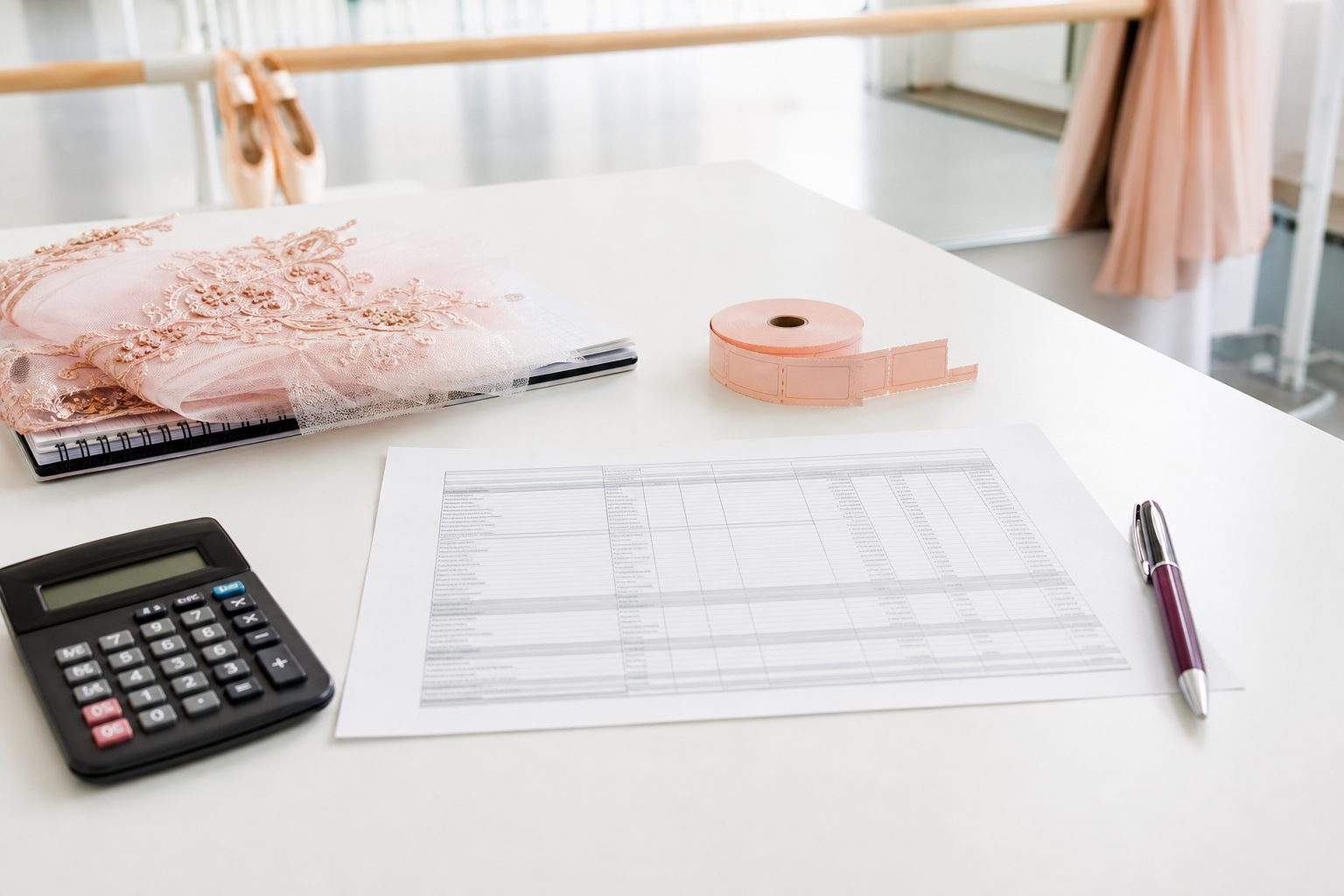
In most studios, the recital fee is not profit and is not close to it. It is a cost recovery charge, and the largest single slice of it is the building: venue rental plus the technical labor the venue requires you to hire. Depending on your market and your headcount, the theater side alone commonly eats somewhere between a third and two thirds of what you collect per dancer.
The rest goes to lighting and sound labor, music licensing, program printing, tickets, awards, backstage supplies and the staff hours nobody bills for. Whether costumes are in the fee at all depends on how you set it up, and that one decision changes the number more than anything else on the list.
What follows is the anatomy of the fee, plus a worked example you can run against your own actuals. The numbers in the example are assumptions, chosen to be plausible for a mid size US studio. Yours will differ. The structure will not.
The cost categories inside a single recital fee
Every dollar you collect lands in one of seven buckets:
- Venue. Rental, load in and load out hours, any required house staff.
- Technical labor. Lighting designer or operator, sound operator, stagehands, spot operators.
- Licensing and rights. Performance licensing where applicable, and any rights fee for choreography you did not create.
- Costumes. Only if bundled into the fee rather than billed separately.
- Printed and physical goods. Programs, tickets, awards, backdrops, props, backstage supplies.
- Staffing. Your own instructors and administrators paid for rehearsal, dress rehearsal and show day hours.
- Contingency. The overage line that saves you when strike runs long.
The useful distinction, and the one this article keeps returning to, is that the first two are almost entirely fixed. They cost the same whether 140 dancers walk onstage or 260 do.
Keep reading: What actually happens on placement day when I move dancers up a level in ballet?
Venue rental, load in hours and the house crew question
Venue quotes are rarely a single number. A high school auditorium might quote a flat day rate plus a custodial charge plus a technician minimum. A performing arts center is more likely to quote an hourly rate against a minimum call, with everything from the box office to the piano tuning as a separate line.
Two questions decide your real cost. First: does your rental clock start at load in or at curtain? If you need four hours to lay floor, hang a backdrop and focus lights, and the clock is running, that is four hours of rental you may not have budgeted. Second: are you required to hire house crew, and at what minimum call? Many union or district houses require a four hour minimum per person even if you need ninety minutes.
Ask both questions in writing before you sign. The difference between a venue that lets you bring your own two person crew and one that requires four house hands at a four hour minimum can easily be a four figure swing on a single show day.
Lighting, sound and the technical labor line studios underestimate
This is the line most first time budgets get wrong, because studio owners price the show and forget the rehearsal.
A one performance recital with a proper dress rehearsal usually needs your technical people for two calls, not one. The dress rehearsal call is when lighting looks are built and sound levels are set. If you skip it, you are building looks during the show, which is why some recitals are lit in one flat wash from start to finish.
Budget technical labor as: number of technicians, times hours per call, times two calls, times the rate. Three people at six hours across two days at forty dollars an hour is $1,440 before anyone has printed a program. That is the arithmetic, and it is why the technical line is rarely small.
Costume cost per dancer and whether it is billed separately or bundled
Costumes are the one truly per dancer cost in the whole budget, and they are the reason two studios with identical shows can quote wildly different recital fees.
Bundling makes the fee look large and makes your billing simple: one charge, one due date, one collection effort. Billing separately makes the recital fee look modest and gives you a clean pass through, but it means two invoices, two due dates, and a second round of chasing.
There is a third structure worth knowing: bundle costumes but stage the billing. Charge a costume deposit when sizing is collected, because that is when you have to place the vendor order, then charge the balance of the recital fee closer to the show. Families feel two moderate charges rather than one large one, and your cash arrives when your vendor invoice does.
Keep reading: How do I set term tuition for my ballet school when families want to pay monthly instead?
Program printing, tickets, awards and backstage supplies
Small lines, but they add up, and they are almost all fixed rather than per dancer.
| Item | Behaves as | Notes |
|---|---|---|
| Programs | Mostly fixed | Setup and design dominate; per copy cost is minor |
| Tickets | Fixed or per ticket | Digital platforms usually charge a per ticket fee |
| Awards and trophies | Per dancer | Scales directly with headcount |
| Backdrop and props | Fixed | Amortize a purchased backdrop across several years |
| Backstage supplies | Mostly fixed | Pins, hairspray, first aid, tape, water |
| Flowers and gifts | Per dancer | Often better as an optional add on sale |
Fixed cost versus per dancer cost and why headcount changes everything
Here is the part worth doing on paper, because it explains why your fee felt fine two years ago and feels tight now.
Split your budget into a fixed pile and a per dancer pile. Assume the following, and treat every figure as an assumption for illustration only:
- Venue rental including load in: $4,000
- House crew minimum: $1,600
- Technical labor across two calls: $1,440
- Licensing: $300
- Program design and printing: $900
- Backdrop rental, props, backstage supplies: $700
- Studio staff hours for rehearsal and show day: $2,200
- Contingency at ten percent of the above: $1,114
Fixed total: $12,254. Per dancer costs, excluding costumes: award at $8 and a ticketing fee absorbed on two comped seats at $4, so $12 per dancer.
Now run it at two headcounts. At 180 dancers, fixed cost per dancer is $12,254 divided by 180, which is $68.08. Add $12 and your break even recital fee is $80.08. At 260 dancers, the same fixed pile divides down to $47.13, and break even falls to $59.13.
Same show. Same building. A $21 per dancer difference driven entirely by headcount. That is the whole reason a soft enrollment year makes recital season feel like it is bleeding money.
See how TutuTerm handles this for dance and ballet schools
Dividing the total across dancers, families or ticket price
You have three levers, and most studios use a blend of all three without ever saying so out loud.
Per dancer. Clean and fair in the sense that the cost follows participation. Punishing for the family with three children, who pays triple for one show. A sibling discount is a partial fix and should be priced in deliberately, not applied at the counter.
Per family. Kinder to multi child households, and easier to explain, but it moves cost onto single child families and makes your revenue harder to forecast because it depends on family composition rather than roster count.
Through ticket price. Every dollar you move from the fee into the ticket lowers the visible fee and raises the door revenue. It also shifts cost onto grandparents and extended family, which some communities accept happily and others resent. If your venue takes a cut of ticket sales, check that first, because you may be sharing that revenue with the house.
A decision rule
Calculate break even per dancer at your realistic low headcount, not your hoped for one. Set the fee there. Then decide whether anything above break even should come from ticket price or from add on sales like flowers, videos and photo packages, which are optional and therefore easier for families to accept.
Setting next year's fee from this year's actual numbers
Within two weeks of strike, while the invoices are still fresh, build one sheet with three columns: budgeted, actual, and variance. Every line from this article gets a row.
Then answer four questions in writing.
- Which line had the largest overage, and was it a one time event or a structural underestimate?
- What was our actual final dancer count, versus the count we used to set the fee?
- Did we go over contracted venue hours, and by how much?
- What did we spend staff hours on that a process could have absorbed?
File that sheet where you will find it next January. The single most common reason studios repeat a bad fee is that nobody wrote down what actually happened.
Knowing the number before you have to defend it
The fee conversation with a skeptical parent gets easy the moment you can name the categories and say what share each one takes. It gets easier still when the headcount you set the fee against is a live number rather than a guess.
That is the practical case for keeping enrollment, costume sizing and recital billing connected. TutuTerm handles term enrollment with class placement, collects costume sizes per dancer, and bills recital fees in stages, so the roster you divide fixed costs across is the roster you actually have, and the deposit lands when the costume order does.
Read also

What actually happens on placement day when I move dancers up a level in ballet?
An hour by hour account of a placement session at a children's ballet school: what faculty watch for, how classes get balanced afterward, and how results reach families without a week of appeals.

How do I set term tuition for my ballet school when families want to pay monthly instead?
Term pricing and monthly billing are two different decisions. Here is how to price a full term of classes, then split that number into even installments without losing revenue to short months or holiday weeks.
Should I rent recital costumes or buy them outright for every dancer in my school?
Renting keeps parent cost down and storage small. Buying gives families a keepsake and you a predictable margin. Compare the two on cash flow, sizing risk, cleaning and what happens when a dancer withdraws.